
Ordinary Saints
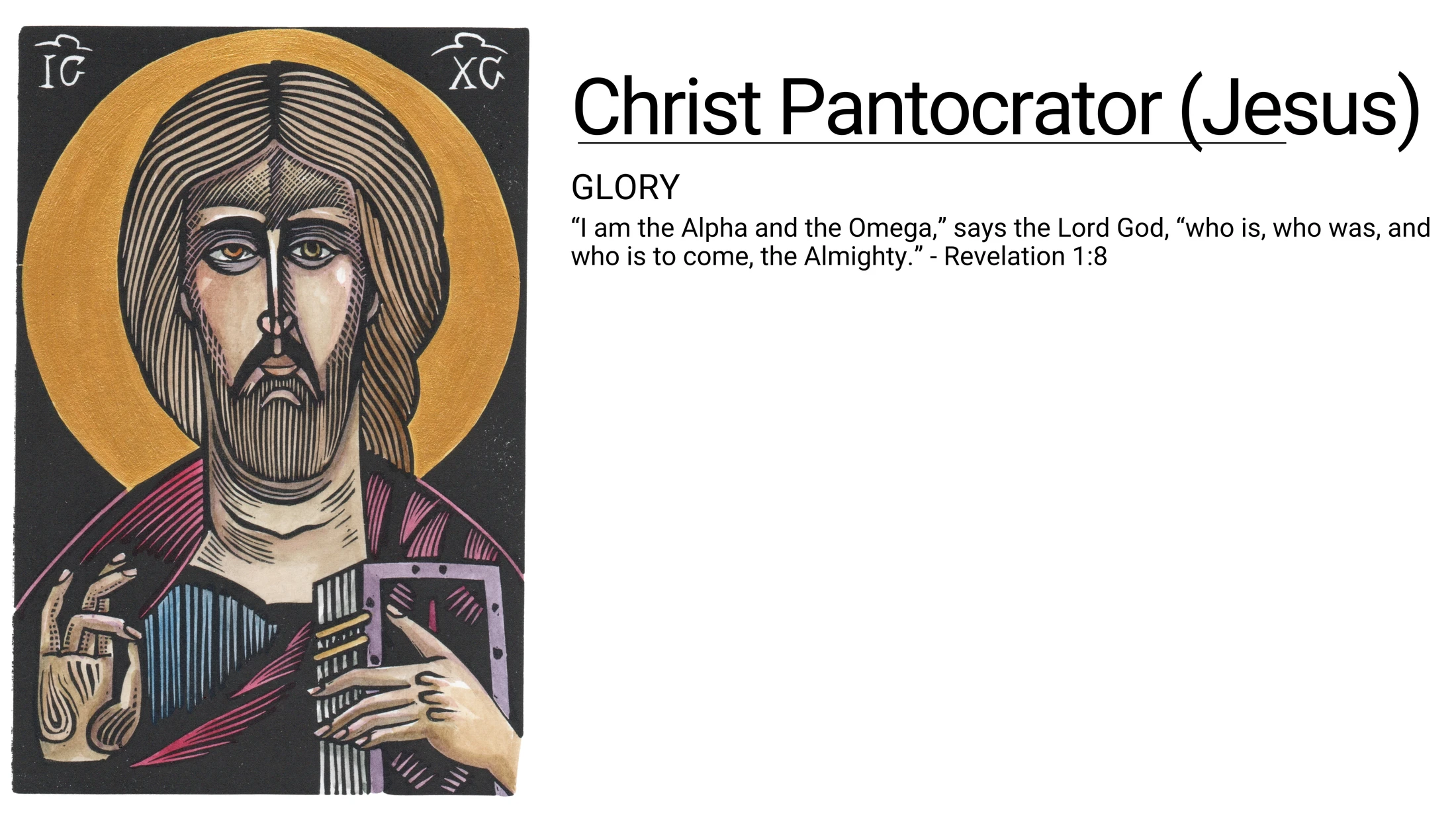
Christ Pantocrator (Jesus)
Glory
The Lord bless you and keep you, the Lord make his face shine upon you... the Lord turn his face toward you and give you peace. In the name of the Father, the Son, and the Holy Spirit, Amen.
Jesus Christ, Pantocrator: The Lord of the Universe, Almighty, Ruler of all. The Pantocrator icon is considered one of the oldest Byzantine icons of the Savior. The initial iconographer wrote in the image what St. John painted in words: “The Word was God...The Word became flesh and made his dwelling among us” (John 1:1, 14).
During the fourth century, people of Christian faith struggled against heresies concerning Christ’s divinity and humanity. Saint Athanasius remained steadfast to St. John’s gospel theology and opposed these attacks. The Nicene Creed, written in the year 325, would lay down the tenets of the faith, affirming that “Christ was the visible and perfect image of the Father.”
The members of the council that created the creed recorded that Christ was “true God from true God, begotten, not made, consubstantial with the Father; through him all things were made.” Consubstantial means “of the same substance.” Christ was begotten, unlike us, who are created.
The iconographer presents this dualistic nature of Christ – God and human – by painting a human side and an “otherworldly” half. It is subtle, but it’s there nonetheless. Christ holds the Gospels in one hand while blessing the viewer with the other. His eyes pierce our soul. They looking longingly and lovingly at us. We are his beloved, loved from the foundation of the world! There is nothing he wouldn’t do so as to never be separated from us.
“The Cross of the Lord is a sign of victory over death,” Athanasius reminds us. Look on the victorious Christ in all his glory, and hear his words: “I am the resurrection.” Christ has defeated death. He is risen! He is risen indeed!
About the portrait collection, from the artist, Kreg Yingst (from the introduction of his book, “Everything Could Be A Prayer.”
I began creating icon-style portraits as a New Year’s resolution at the beginning of 2013. Creating them was a means of confronting the darkness around us – more specifically, as a direct response to the Sandy Hook school shooting. Through my art, I wanted to bring light and healing: something tangible that could be seen and held. Prayers that the viewer could speak. Images that contemplate that might offer a sense of peace and solace.
My daily devotional routine was to find a prayer – one per week – and then meditate on it, draw it, carve it, print it, and paint it. Each block print featured the saint or mystic who had spoken the prayer. By the end of the year, I had completed 52 prints.
In the ensuing years, I’d occasionally do one, but my work on these portraits was sporadic at best. Then in 2020 the pandemic struck, and many of us encountered solitude in a new way. George Floyd was murdered by police, and the country and the world faced a renewed reckoning with the persistence of injustice and racism. In despair and dogged by a sense of hopelessness, I decided to again focus on this spiritual discipline. I needed models of faithful Christian witness in times of suffering and fear. This time I searched for wisdom of self-imposed hermits and leaders from marginalized communities.
The collection that emerged features portraits of people of faith: saints and mystics from different periods, cultures, ethnicities, genders, and denominations. They are contemplatives and activists, well-known and obscure, Orthodox and Protestant and Catholic... Their commonality is their love for God and their enduring awareness of God’s love for them.
The saints and mystics in this book share a deep and abiding devotion to Christ, whose essence shines through them. But not all aspects of their lives are commendable. Like the writer of Hebrews names as ancients commended for their faith, they were certainly not perfect. Yet put together, these saints and mystics offer us a colorful light spectrum seen through a God-shaped prism, each an individual piece of glass. When the pieces are assembled, they form a stained-glass window that reveals the imago Dei: the image of God written into humanity.
Artwork by Kreg Yingst. Used with permission.