
Ordinary Saints | Lent Week 1
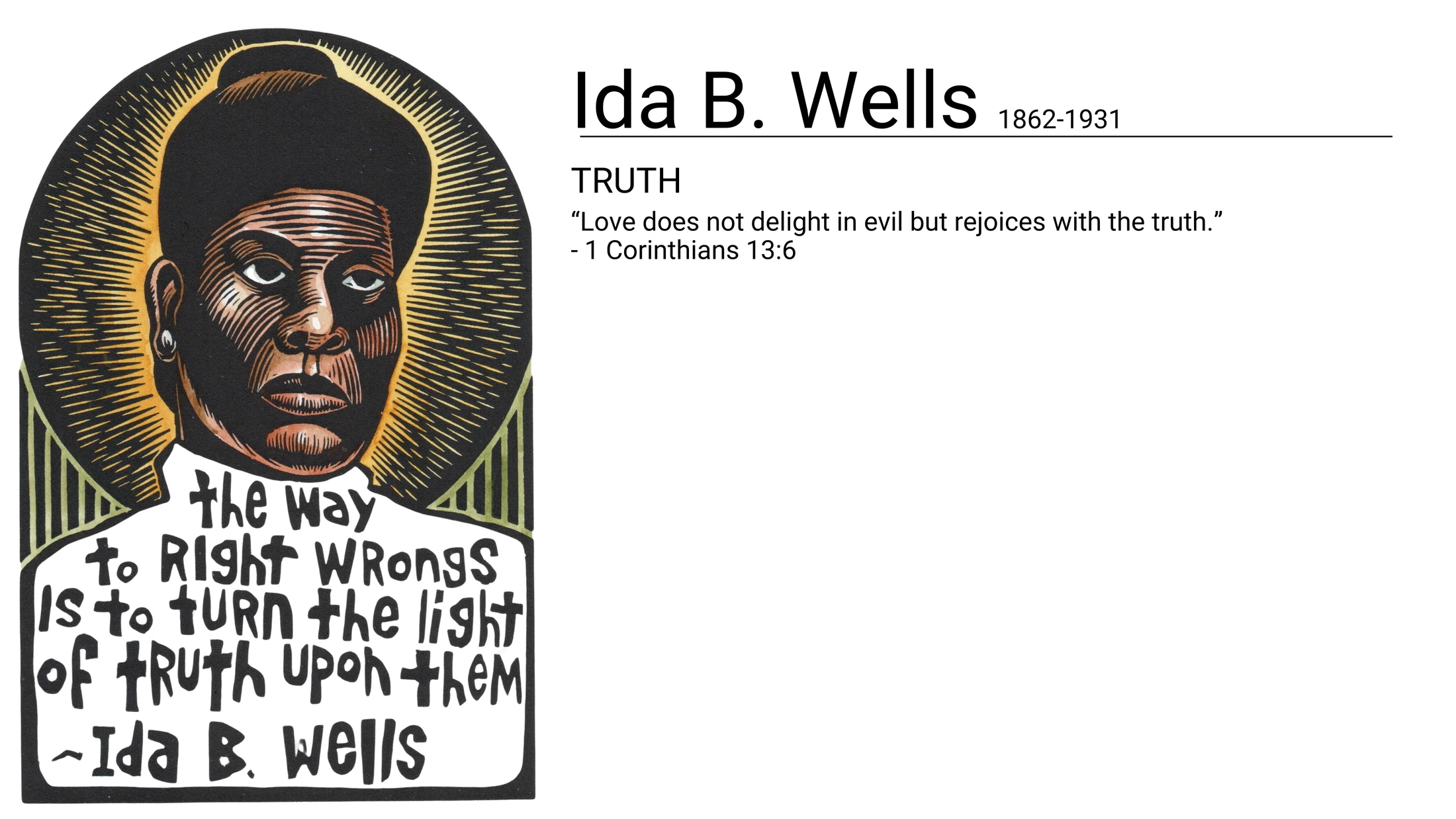
Ida B. Wells
1862-1931
Truth
“Love does not delight in evil but rejoices with the truth.” -1 Corinthians 13:6
God of Truth, expose the evils of injustice. Bring healing to the victims and families of such atrocities. Help me lend my voice to others who are seeking to remedy wrongs; hear our cry. Amen.
Long before Rosa Parks chose to remain seated on the bus, Ida B. Wells did likewise in a train car. Both women challenged the same unjust system.
In 1884, Wells was asked by the conductor of the Chesapeake & Ohio Railroad Company to move from her first-class car seat – for which she had a ticket – to the Jim Crow section of the train. She refused, and she was subsequently forcibly removed. Under the Civil Rights Act of 1875, Wells filed and won a lawsuit against the company. Although she was awarded a settlement, not surprisingly, the verdict was appealed and reversed by the Tennessee Supreme Court.
This incident, followed by the lynching of three friends, set Wells on a course to seek social justice and stop anti-Black violence. She began her career as a prominent journalist by writing church editorials exposing racial injustice. Her prophetic voice empathized with the oppressed; it exposed lies, confronted evils, and appealed for transformation. “There must always be a remedy for wrong and injustice if we only know how to find it,” Wells claims.
Activism became a natural extension of her contemplative life. Without God, there would be no change. “I do not fear,” Wells writes in her diary. “God is over all and He will, so long as I am in the right, fight my battles and give me what is my right.”
Ida B. Wells became a founding member of the National Association for the Advancement of Colored People in 1909. This community effort paved the way for the civil rights movement. Her passionate work to stop lynchings – along with that of Mamie Till and others – was finally realized on March 29, 2022, when the Emmett Till Antilynching Act made lynching a federal hate crime.
Ida B. Wells found remedies for wrong and injustice. She exposed lies and revealed truth.
About the portrait collection, from the artist, Kreg Yingst (from the introduction of his book, “Everything Could Be A Prayer.”
I began creating icon-style portraits as a New Year’s resolution at the beginning of 2013. Creating them was a means of confronting the darkness around us – more specifically, as a direct response to the Sandy Hook school shooting. Through my art, I wanted to bring light and healing: something tangible that could be seen and held. Prayers that the viewer could speak. Images that contemplate that might offer a sense of peace and solace.
My daily devotional routine was to find a prayer – one per week – and then meditate on it, draw it, carve it, print it, and paint it. Each block print featured the saint or mystic who had spoken the prayer. By the end of the year, I had completed 52 prints.
In the ensuing years, I’d occasionally do one, but my work on these portraits was sporadic at best. Then in 2020 the pandemic struck, and many of us encountered solitude in a new way. George Floyd was murdered by police, and the country and the world faced a renewed reckoning with the persistence of injustice and racism. In despair and dogged by a sense of hopelessness, I decided to again focus on this spiritual discipline. I needed models of faithful Christian witness in times of suffering and fear. This time I searched for wisdom of self-imposed hermits and leaders from marginalized communities.
The collection that emerged features portraits of people of faith: saints and mystics from different periods, cultures, ethnicities, genders, and denominations. They are contemplatives and activists, well-known and obscure, Orthodox and Protestant and Catholic... Their commonality is their love for God and their enduring awareness of God’s love for them.
The saints and mystics in this book share a deep and abiding devotion to Christ, whose essence shines through them. But not all aspects of their lives are commendable. Like the writer of Hebrews names as ancients commended for their faith, they were certainly not perfect. Yet put together, these saints and mystics offer us a colorful light spectrum seen through a God-shaped prism, each an individual piece of glass. When the pieces are assembled, they form a stained-glass window that reveals the imago Dei: the image of God written into humanity.
Artwork by Kreg Yingst. Used with permission.