
Ordinary Saints | Lent Week 2
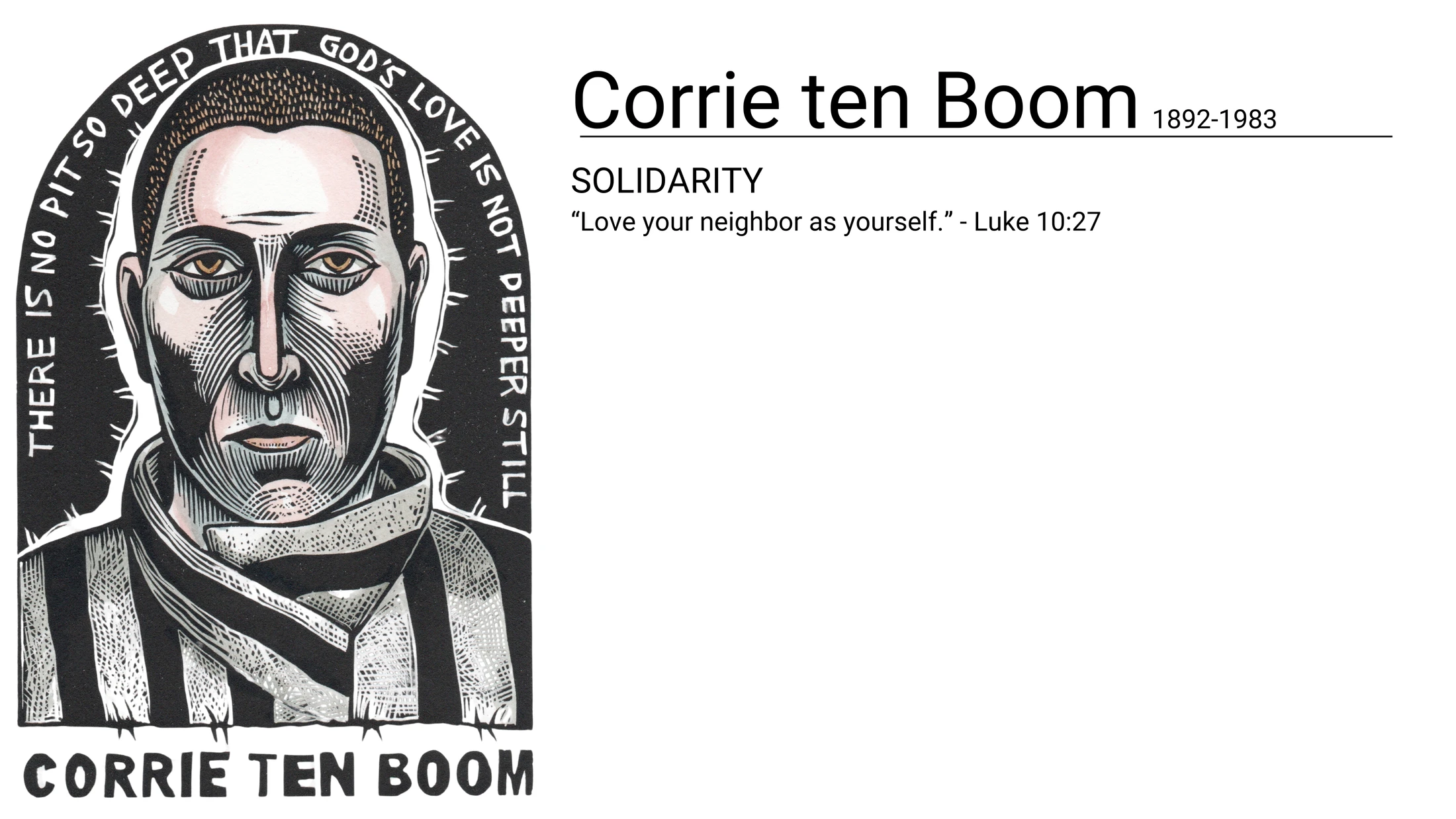
Corrie ten Boom
1892-1983
Solidarity
“Love your neighbor as yourself.” - Luke 10:27
God, my hiding place, give me empathy and courage to love even in difficult situations. Grant me wisdom and discernment in pursuing solidarity and pursuing your will. Amen.
We must often choose between safety and solidarity. If someone is being treated cruelly and unfairly, we can choose our own safety, or we can choose to stand with them.
This was the choice Corrie ten Boom and her family faced. The Nazi regime had taken over Holland. Boys were being taken from the streets and forced to work. Jewish people were being rounded up and shipped off by train to undisclosed locations. The rumors began floating around: unimaginable stories, about death camps and torture.
Corrie, her sister, and their elderly father knew they had to make a decision: a dangerous decision that might cost them their very own lives. They chose solidarity. “It is not my ability, but my response to God’s ability that counts,” Corrie acknowledges. They constructed a hiding place that harbored Jews while they worked to arrange their escape.
When the Nazis discovered what the ten Booms were doing, they imprisoned Corrie’s father, who died shortly thereafter. Corrie and her sister got shipped off to Ravensbrück concentration camp. There Corrie witnessed the death of her sister and other horrors. Yet she was able to proclaim what her sister had told her: “There is no pit so deep that God’s love is not deeper still.”
Jesus tells the story of a man who is beaten, stripped, robbed, and left for dead on the side of the road. Two religious men – a priest and a Levite – pass him by. Was this a setup? they must have wondered. Will they do the same to me if I stop to help? They had a decision to make, and they chose their own safety. A third man, a Samaritan outcast, came by and cared for their victim, bandaged his wounds, and found him a place to stay – all at personal cost.
The story’s hero was not the priest or the Levite but the one who loved his neighbor in tangible ways. Jesus says, “Go and do likewise.”
About the portrait collection, from the artist, Kreg Yingst (from the introduction of his book, “Everything Could Be A Prayer.”
I began creating icon-style portraits as a New Year’s resolution at the beginning of 2013. Creating them was a means of confronting the darkness around us – more specifically, as a direct response to the Sandy Hook school shooting. Through my art, I wanted to bring light and healing: something tangible that could be seen and held. Prayers that the viewer could speak. Images that contemplate that might offer a sense of peace and solace.
My daily devotional routine was to find a prayer – one per week – and then meditate on it, draw it, carve it, print it, and paint it. Each block print featured the saint or mystic who had spoken the prayer. By the end of the year, I had completed 52 prints.
In the ensuing years, I’d occasionally do one, but my work on these portraits was sporadic at best. Then in 2020 the pandemic struck, and many of us encountered solitude in a new way. George Floyd was murdered by police, and the country and the world faced a renewed reckoning with the persistence of injustice and racism. In despair and dogged by a sense of hopelessness, I decided to again focus on this spiritual discipline. I needed models of faithful Christian witness in times of suffering and fear. This time I searched for wisdom of self-imposed hermits and leaders from marginalized communities.
The collection that emerged features portraits of people of faith: saints and mystics from different periods, cultures, ethnicities, genders, and denominations. They are contemplatives and activists, well-known and obscure, Orthodox and Protestant and Catholic... Their commonality is their love for God and their enduring awareness of God’s love for them.
The saints and mystics in this book share a deep and abiding devotion to Christ, whose essence shines through them. But not all aspects of their lives are commendable. Like the writer of Hebrews names as ancients commended for their faith, they were certainly not perfect. Yet put together, these saints and mystics offer us a colorful light spectrum seen through a God-shaped prism, each an individual piece of glass. When the pieces are assembled, they form a stained-glass window that reveals the imago Dei: the image of God written into humanity.
Artwork by Kreg Yingst. Used with permission.