
Ordinary Saints | Lent Week 3
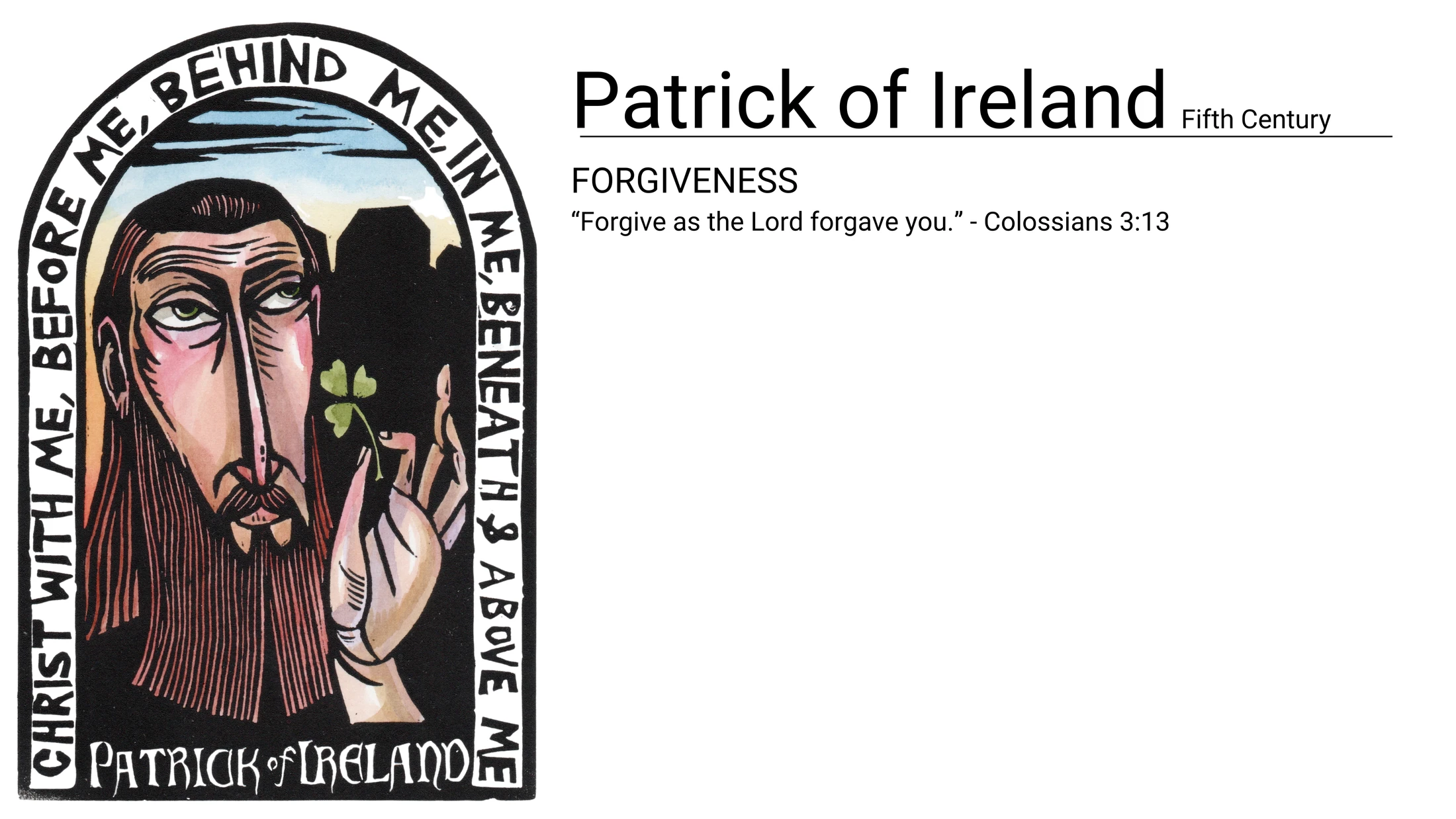
Patrick of Ireland
Fifth Century
Forgiveness
“Forgive as the Lord forgave you.” - Colossians 3:13
I arise today, through
God’s strength to pilot me,
God’s might to uphold me,
God’s wisdom to guide me,
God’s eye to look before me,
God’s ear to hear me,
God’s word to speak for me,
God’s hand to guard me,
God’s shield to protect me,
God’s host to save me.
Amen.
Led by a vision, young St. Patrick traversed the lush green meadows and hills, making his way to the coast. For many days he traveled, avoiding contact with strangers, until he arrived at the harbor and saw the ship from his dream. Quickly securing passage, he offered a prayerful sigh of thanks as he boarded. Enslaved no more, Patrick was bound for his home in Britain!
One can hardly imagine what went through his head when God called him back to the place of his captivity. Now a bishop, he was sent there to share the good news of God’s reconciliation. Patrick discovered the depth of God’s love the day he stepped off the boat: standing on the Rock of Mercy, his heart enlarged to embrace all of Ireland.
Patrick later wrote in his Confessions, “After my many hardships and misfortunes, after such great difficulties and burdens, after my captivity and enslavement, after so many years living among the Irish, He should give me so great a grace in behalf of this nation of people – something that once, in my boyhood, I never dreamed nor could even hope for.”
Forgiveness is a God-given gift. When that gift is exercised, there’s no telling what is possible. Patrick’s impact on the Emerald Isle would be undeniable; his name is associated with Ireland for all time.
When Peter asks Jesus how many times he must forgive, Jesus says seventy-seven. Forgiveness frees not just the perpetrators of wrongdoing but the survivors of it. St. Patrick found a way to forgive and to be free.
About the portrait collection, from the artist, Kreg Yingst (from the introduction of his book, “Everything Could Be A Prayer.”
I began creating icon-style portraits as a New Year’s resolution at the beginning of 2013. Creating them was a means of confronting the darkness around us – more specifically, as a direct response to the Sandy Hook school shooting. Through my art, I wanted to bring light and healing: something tangible that could be seen and held. Prayers that the viewer could speak. Images that contemplate that might offer a sense of peace and solace.
My daily devotional routine was to find a prayer – one per week – and then meditate on it, draw it, carve it, print it, and paint it. Each block print featured the saint or mystic who had spoken the prayer. By the end of the year, I had completed 52 prints.
In the ensuing years, I’d occasionally do one, but my work on these portraits was sporadic at best. Then in 2020 the pandemic struck, and many of us encountered solitude in a new way. George Floyd was murdered by police, and the country and the world faced a renewed reckoning with the persistence of injustice and racism. In despair and dogged by a sense of hopelessness, I decided to again focus on this spiritual discipline. I needed models of faithful Christian witness in times of suffering and fear. This time I searched for wisdom of self-imposed hermits and leaders from marginalized communities.
The collection that emerged features portraits of people of faith: saints and mystics from different periods, cultures, ethnicities, genders, and denominations. They are contemplatives and activists, well-known and obscure, Orthodox and Protestant and Catholic... Their commonality is their love for God and their enduring awareness of God’s love for them.
The saints and mystics in this book share a deep and abiding devotion to Christ, whose essence shines through them. But not all aspects of their lives are commendable. Like the writer of Hebrews names as ancients commended for their faith, they were certainly not perfect. Yet put together, these saints and mystics offer us a colorful light spectrum seen through a God-shaped prism, each an individual piece of glass. When the pieces are assembled, they form a stained-glass window that reveals the imago Dei: the image of God written into humanity.
Artwork by Kreg Yingst. Used with permission.