
Ordinary Saints | Lent Week 4
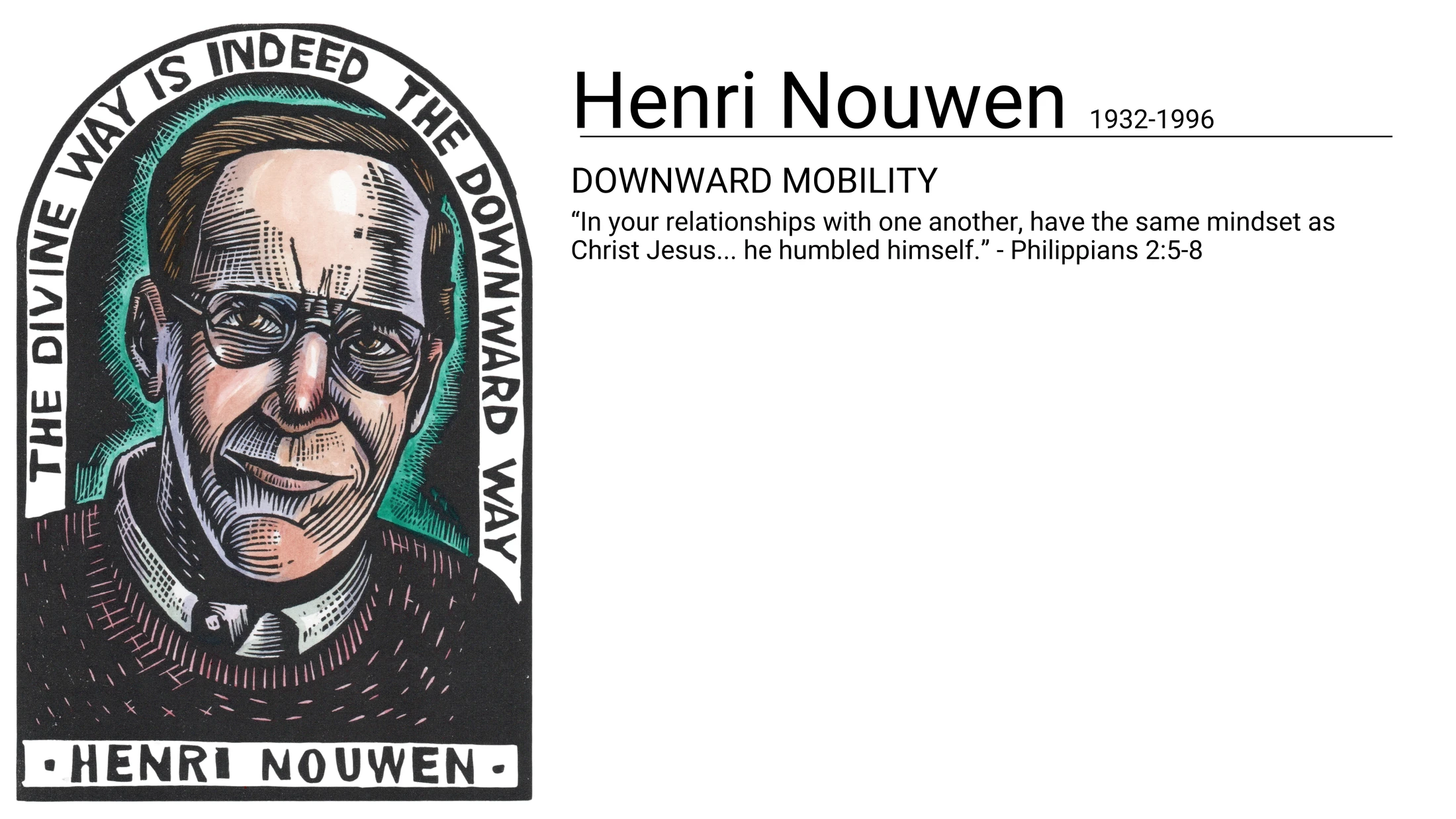
Henri Nouwen
1932-1996
Downward Mobility
“In your relationships with one another, have the same mindset as Christ Jesus... he humbled himself.” - Philippians 2:5-8
Cruciform Christ, I relinquish to you – my loving caretaker and friend – the control of my life that I so desperately desire to hold onto. I will walk through the doors that you open, and not those of my own making. Amen.
For spiritual writer and priest Henri Nouwen, pursuing a radical Christian life was the ultimate priority. He came to describe this as “downward mobility.” “Just as we came to see God in the downward way of Christ, so we will become conscious of truly being sons and daughters of God by becoming participants in this downward way, the way of the cross,” Nouwen asserts. This upside-down kingdom is the polar opposite of the world’s ways, where success is measured by how far one can climb up the ladder of riches, power, and prestige.
Nouwen relinquished a position at Harvard Divinity School in 1986, taking up residence as a mentor at a community of those with mental and physical disabilities. It was here that Nouwen found fulfillment. His final year there was recorded in his published journal, The Road to Daybreak: A Spiritual Journey.
In his book The Selfless Way of Christ, Nouwen points to the wilderness temptations Jesus faced as challenges that plague the church to his day: to be relevant, spectacular, and powerful. Jesus not only preached on these dangers but lived his life in opposition to them. The church in the West has come to see signs of upward mobility – job promotions, bigger houses, and fancier cars – as blessings from God. But these are merely the goals of the American consumer.
Nouwen invites us to step back and take a broader perspective. Rather than always grabbing for the gold ring, we can relinquish our desires and exchange them for God’s will. We can choose the downward way.
About the portrait collection, from the artist, Kreg Yingst (from the introduction of his book, “Everything Could Be A Prayer.”
I began creating icon-style portraits as a New Year’s resolution at the beginning of 2013. Creating them was a means of confronting the darkness around us – more specifically, as a direct response to the Sandy Hook school shooting. Through my art, I wanted to bring light and healing: something tangible that could be seen and held. Prayers that the viewer could speak. Images that contemplate that might offer a sense of peace and solace.
My daily devotional routine was to find a prayer – one per week – and then meditate on it, draw it, carve it, print it, and paint it. Each block print featured the saint or mystic who had spoken the prayer. By the end of the year, I had completed 52 prints.
In the ensuing years, I’d occasionally do one, but my work on these portraits was sporadic at best. Then in 2020 the pandemic struck, and many of us encountered solitude in a new way. George Floyd was murdered by police, and the country and the world faced a renewed reckoning with the persistence of injustice and racism. In despair and dogged by a sense of hopelessness, I decided to again focus on this spiritual discipline. I needed models of faithful Christian witness in times of suffering and fear. This time I searched for wisdom of self-imposed hermits and leaders from marginalized communities.
The collection that emerged features portraits of people of faith: saints and mystics from different periods, cultures, ethnicities, genders, and denominations. They are contemplatives and activists, well-known and obscure, Orthodox and Protestant and Catholic... Their commonality is their love for God and their enduring awareness of God’s love for them.
The saints and mystics in this book share a deep and abiding devotion to Christ, whose essence shines through them. But not all aspects of their lives are commendable. Like the writer of Hebrews names as ancients commended for their faith, they were certainly not perfect. Yet put together, these saints and mystics offer us a colorful light spectrum seen through a God-shaped prism, each an individual piece of glass. When the pieces are assembled, they form a stained-glass window that reveals the imago Dei: the image of God written into humanity.
Artwork by Kreg Yingst. Used with permission.